
Therapist Near Walpole, MA
Most people who reach out to me already know a lot about themselves. You can explain where your patterns came from. You might have done therapy before. And you still end up in the same spot.
You agree to things you don’t want to do. You hold back what you really think. You tell yourself the next hard conversation will be different, and then it isn’t.
Understanding a pattern doesn’t stop it. That’s the part I help with.
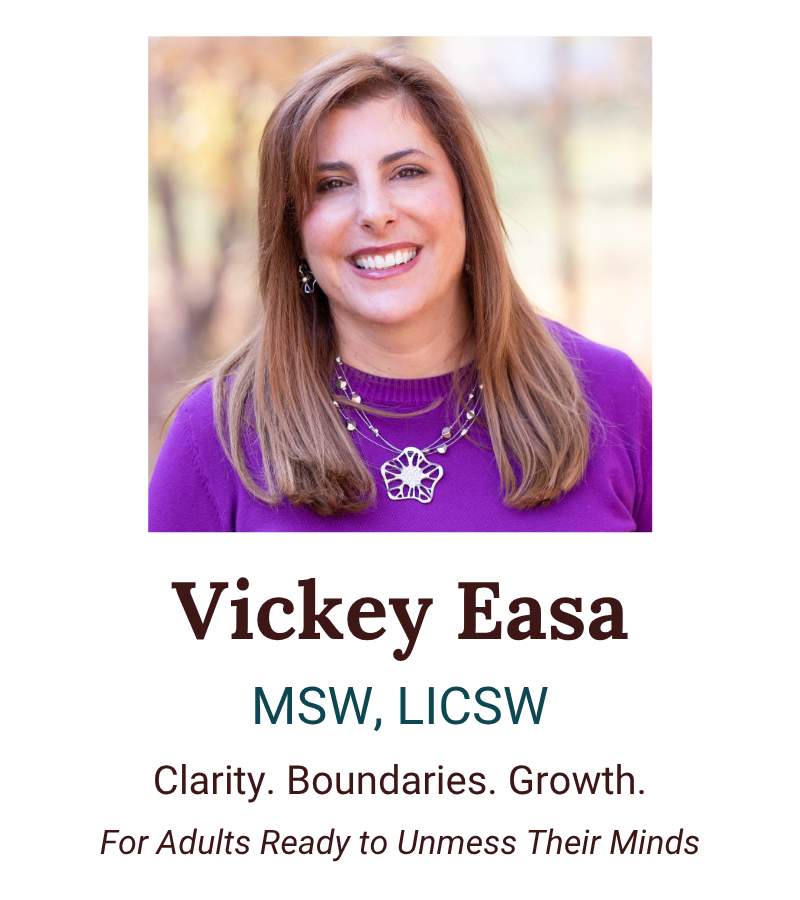
I’m Vickey Easa, a Massachusetts Licensed Independent Clinical Social Worker (LICSW) with nearly 20 years of experience as a mental health therapist. My office is in Norwood, right over the town line from Walpole. I also offer online therapy throughout Massachusetts and New York.
Individual Therapy for Adults in Walpole, MA
I work with men and women, 30 and older, who look like they have it together. You show up for work. You get the kids where they need to be. You handle the calendar, the bills, and everyone else’s feelings. On the inside, it’s a different story. Maybe your mind won’t shut off at night. Maybe you snap at people you love and then replay it for days. Maybe you keep picking the same kind of relationship and getting the same result.
Therapy with me is not quiet nodding. I’ll ask questions. I’ll tell you what I’m noticing. Sometimes I’ll say, “Can I push on that for a second?” And when I’m guessing, I’ll say so. If my guess is off, that’s useful too. It tells us where to look next. Learn more about individual therapy.
A lot of my work comes from Parts Work. Say you’re stuck on something you thought you’d moved past. I might ask, “Is there a part of you that’s done with this, and another part that isn’t?” Almost everyone knows that inner tug-of-war. We don’t pick a winner. We get curious about both sides and what each one needs.

Patients often come to me for:
- Relationship patterns that keep repeating
- Overthinking or constant mental noise
- Stress, burnout, or feeling overwhelmed
- Self-esteem and self-worth challenges
- Life transitions or feeling stuck in the “in-between”
- Difficulty managing emotions or reactions
- Childhood trauma or early experiences
- Depression and anxiety
- Grief, anger, or feeling stuck
- Career-related stress and pressure

Therapy for Women
Many of the women I work with are holding everything together and explaining things three different ways, hoping one finally lands. Something that’s helped me personally: when whatever I do is wrong either way, I take that as a huge signal that it isn’t about me. Learning to spot that is often where change starts.
Therapy for Men
A lot of the men I work with were never asked what they feel, only what they’re going to do about it. So they shut down, get defensive, or say “got it” just to end the conversation. Therapy isn’t a lecture here. It’s a place to figure out what’s going on underneath.
With me, therapy works best when you actually want to be there.
Therapy for Men
A lot of the men I work with were never asked what they feel, only what they’re going to do about it. So they shut down, get defensive, or say “got it” just to end the conversation. Therapy isn’t a lecture here. It’s a place to figure out what’s going on underneath.
Therapy for Women
Many of the women I work with are holding everything together and explaining things three different ways, hoping one finally lands. Something that’s helped me personally: when whatever I do is wrong either way, I take that as a huge signal that it isn’t about me. Learning to spot that is often where change starts.
Working Through Trauma in Therapy
Trauma isn’t always one big event. Sometimes it’s growing up in a home where you had to watch everyone’s mood before you walked into a room. Sometimes it’s learning that love came easier when you were “good,” quiet, or helpful. Those early lessons stick. They shape how you react today, often before you even notice it happening.
Parts Work runs through everything I do, and it’s especially helpful with trauma. It’s related to Internal Family Systems, but I’m not IFS-certified, and I don’t follow its structured model.
Most of us have a part that snaps, shuts down, or says yes when we mean no. Then we wonder why we keep doing it. That reaction usually started a long time ago, in our families or early relationships, as a way to get through something hard. It made sense back then.
Together, we trace where it came from. That’s where we start. From there, we work on responding the way you want to, instead of the way you always have.

Couples & Marriage Therapy Walpole, MA
You love each other. You also keep having the same fight. One of you explains, then explains again. The other says “got it” so the conversation can end. Nothing changes. And the next time someone says “got it,” it means even less.
That’s rarely just a communication problem. It’s a trust problem that shows up in how you communicate. The argument might be about parenting, money, intimacy, in-laws, or who forgot to follow up (again). The fight on the surface is almost never the whole story.
My Approach to Couples Therapy
My couples therapy is built on Relational Life Therapy (RLT) and Parts Work. RLT looks at the dynamic between the two of you, and it asks each of you to own your part. Parts Work helps each of you notice what’s happening inside you in the heat of the moment, so you can respond instead of react.
In session, I’m active. I’ll stop a conversation to ask, “Can I rephrase that? Do I have it?” I’ll name a pattern when I see it, and I’ll be clear that I’m tracking the pattern, not blaming a person. We’ll also practice real tools, like how to have a repair conversation after a fight.
I usually start by asking what’s going well, even if it’s small. Couples who are struggling tend to stop noticing the good stuff. It still matters. Sometimes it matters most.
My work is focused on adults and couples who want to understand why they keep doing things they don’t want to do. You might already have plenty of insight. Therapy helps you take that insight one step further, so you can trust yourself to make choices that feel right.

In-Person and Online Therapist Near Walpole, MA
My office is in Norwood, just north of Walpole.That makes in-person therapy an easy option for adults and couples living in Canton and surrounding communities, including Westwood, Dedham, Sharon, and Dover.
I also offer virtual therapy throughout Massachusetts and New York if online sessions are a better fit for your schedule. Some patients come in person. Some meet online. Some do both.
Lets Work Together
You don’t need to have everything figured out before reaching out. Maybe you’re tired of having the same argument, with your partner or with yourself. Maybe you know you need to set a boundary and keep not setting it. Or maybe you’ve already done a lot of work on yourself and you’re ready for it to actually show up in how you live.
We can start with a free consultation about what’s been going on and what you’re hoping to change. If it feels like a good fit, we’ll find a time that works for you, in person or online.


What issues can I work on in therapy?
You might be dealing with anxiety, relationship difficulties, childhood experiences, or patterns you can’t seem to change. We can work on understanding what’s underneath those experiences and what it takes to create lasting change.
Can therapy help me change patterns that started in childhood?
Yes. Many of our adult patterns are connected to earlier experiences. We can look at where those patterns came from, why they continue to show up, and how to respond differently.
Is therapy confidential?
Yes. What you share in therapy is completely private.
Do you take insurance?
No, I do not take insurance. I am licensed in MA & NY, so if you have out of network benefits, you may be able to receive reimbursement.